
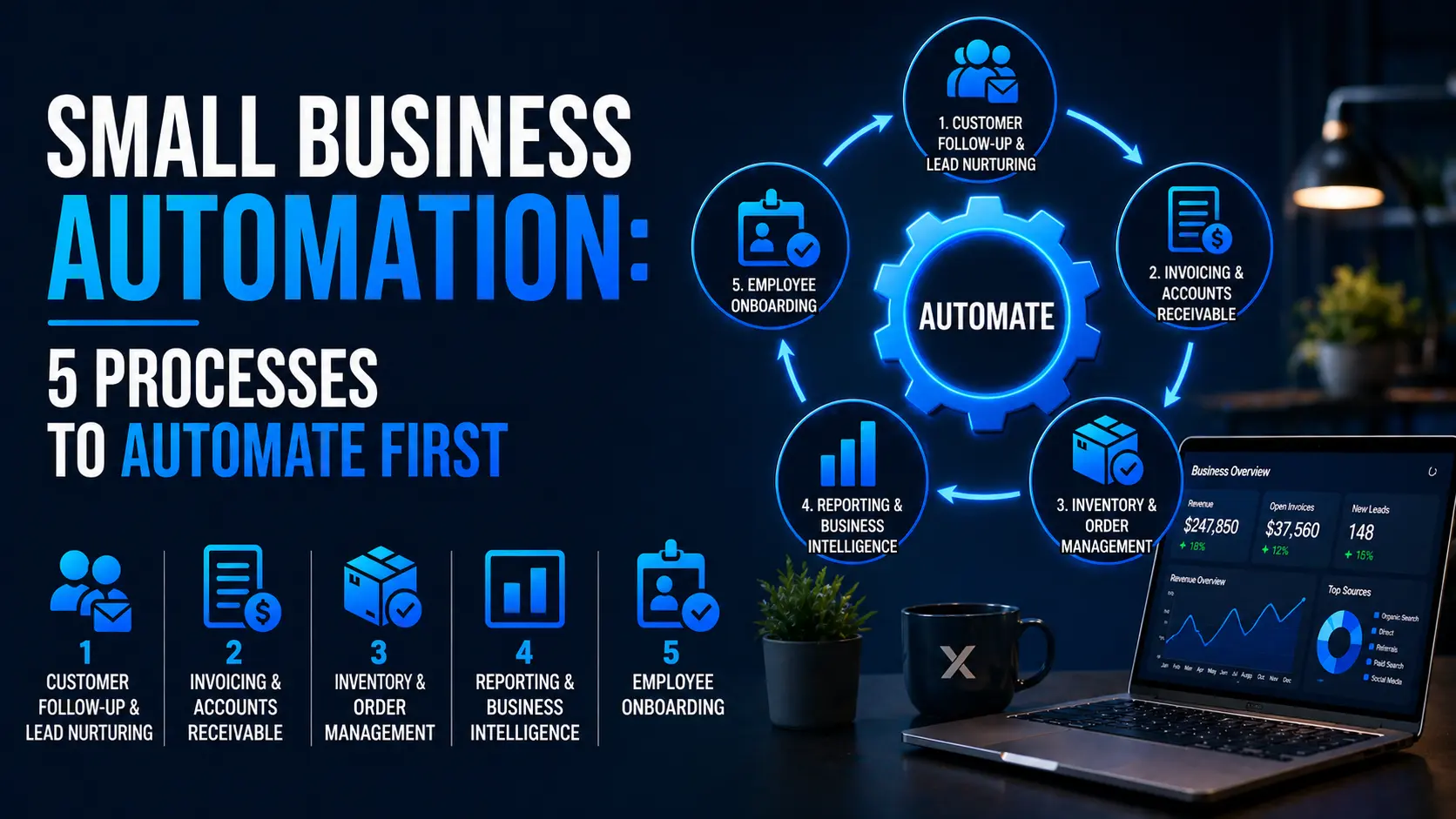
Small Business Automation: 5 Processes to Automate First

InitiumX Team
Business Automation Specialists
Small businesses are the segment that needs automation most. They are running on thin margins, smaller teams, and the owner is often doing work that should not require an owner’s time. Yet small businesses are consistently the last to automate — because the investment feels risky, the options feel overwhelming, and it is hard to know where to start.
The companies that eventually do automate typically discover the same uncomfortable truth: they automated in the wrong order. They started with what was easiest to automate, not what was most expensive to do manually. The result is a set of automated processes that save hours on low-value tasks while the high-cost manual work continues untouched.
The question is not whether to automate — it is which five processes to automate first.
Process 1 - Customer Follow-Up and Lead Nurturing
This is the highest-ROI automation for the majority of small businesses, and it is almost universally underdone.
The problem: a potential customer contacts your business, you send a proposal or have a discovery call, and then the follow-up becomes inconsistent. Busy weeks mean leads go cold. The team member responsible forgets to follow up. The CRM has notes but no action triggers.
The cost is not the time spent on follow-up. The cost is the revenue that walks out the door because no one followed up consistently.
An automated lead nurturing sequence changes this. When a lead enters your system — through a form, an inbound call, or a meeting — a sequence begins automatically: a confirmation email immediately, a follow-up at 48 hours if no response, a value-add email at day 5, a last-touch at day 14. The sequence runs without anyone thinking about it.
Tools for this: HubSpot (free tier covers the basics), ActiveCampaign, or a custom integration between your CRM and email platform. A small business automation consultant can configure these sequences to match your specific sales cycle.
The measurable impact: businesses that implement automated lead nurturing report 15-30% increases in lead-to-close conversion rates. Not because the leads got better — because the follow-up got consistent.
Process 2 - Invoicing and Accounts Receivable
Manual invoicing is one of the most expensive habits a small business can maintain. Not because invoicing takes long — it is that late payments go unnoticed, follow-up is inconsistent, and the owner ends up as the collections department.
An automated invoicing and AR process covers:
- Invoice generation triggered by project milestones or recurring schedules, not by someone remembering to send them
- Automatic payment reminders at day 5, day 15, and day 30 past due — without anyone composing emails
- Late fee application configured in the billing system, not negotiated case by case
- Cash flow dashboards that surface outstanding balances without requiring a manual accounts receivable report
Tools like QuickBooks Online, FreshBooks, or Xero handle most of this natively. The gap is usually not the software — it is that the software is being used manually when it should be running automatically.
Typical outcome: businesses that automate invoicing and AR reduce average days-to-collection by 8-15 days. On a $500,000 annual revenue base, reducing collection time by 10 days frees approximately $13,000 in working capital.
Process 3 - Inventory and Order Management
For product-based businesses, manual inventory management is both time-consuming and error-prone. Stockouts happen because reorder points are not tracked. Over-ordering ties up cash. Order processing requires manual entry across multiple systems.
Automation in inventory and order management means:
- Reorder point triggers that generate purchase orders automatically when stock reaches a defined threshold
- Order-to-fulfillment workflows where a customer order in your e-commerce platform or POS system creates the pick list, updates inventory, and queues shipping without manual re-entry
- Supplier notification automation for standard reorder quantities
- Inventory reconciliation reports generated on a schedule, not on request
Platforms like Shopify, WooCommerce with the right plugins, or tools like Cin7 and Fishbowl handle different tiers of this depending on business size. The key decision is choosing a system where the data flows automatically between sales, inventory, and purchasing — rather than being manually transferred between disconnected tools.
InitiumX builds custom automation workflows that connect existing tools through integrations, often without requiring businesses to replace their current systems entirely.
Process 4 - Reporting and Business Intelligence
Most small businesses generate data in multiple places: sales in the CRM, revenue in QuickBooks, website performance in GA4, ad spend in Google Ads. None of it is connected. The owner who wants to understand business performance has to pull reports from four different tools and reconcile them manually.
Automating reporting means building a system where data flows from all sources into a single dashboard that updates automatically. The owner opens one view and sees:
- Revenue this month vs last month vs target
- Lead volume and conversion rates by source
- Outstanding receivables
- Ad spend and cost per acquisition
- Top-performing products or services
This is not a reporting software decision — it is a data integration decision. Tools like Zapier, Make (formerly Integromat), or custom API integrations connect source systems to a reporting layer like Looker Studio or a custom dashboard.
The time saved is real — typically 3-5 hours per week for an owner or operations manager who was manually pulling and compiling these reports. But the more important benefit is that decisions get made on current data rather than data that is two weeks old by the time it is compiled.
Process 5 - Employee Onboarding
Every time a small business hires someone, the onboarding process is often reinvented from scratch. The manager sends emails with different information each time. Documents are requested at different stages. New employees do not know what to complete by day one versus day five. Time gets wasted on both sides.
Automated onboarding creates a repeatable, consistent experience without requiring manual coordination:
- Document collection triggered automatically on offer acceptance — I-9, W-4, direct deposit, and company-specific forms delivered through a system rather than emailed ad hoc
- Training sequence delivered via email or a learning management system over the first 30 days, not dependent on a manager’s schedule
- Equipment and access requests triggered to IT or operations the day before start, not discovered as missing on day one
- 90-day check-in reminders scheduled automatically to both the manager and the new hire
Tools like Gusto (for HR and payroll automation), BambooHR, or Rippling handle this for most small businesses. The setup investment is typically 8-12 hours of configuration, and the ongoing time savings compound with every new hire.
How to Find the Right Automation Consultant
A small business automation consultant should do two things well: understand your specific business processes, and know which tools solve which problems without over-engineering the solution.
Questions to ask before hiring:
What is your process for deciding what to automate? The right answer involves a process audit before any tool recommendations. Automating the wrong thing faster is not progress.
Do you build custom solutions or only configure off-the-shelf tools? Some problems need custom code. Most do not. A consultant who only knows off-the-shelf tools will force your processes into tools that do not quite fit. One who only builds custom will spend more than necessary.
What does ongoing support look like? Automated systems need maintenance. Integrations break. Tools update their APIs. A consultant who disappears after delivery leaves you with a system you cannot maintain.
Can you show examples from businesses similar in size to mine? Automation strategy for a $2M revenue business is fundamentally different from automation for a $50M business. Experience at your scale matters.
InitiumX works with small and mid-sized businesses to map, prioritize, and implement automation that reduces manual work and improves business visibility. We build integrations between your existing tools, develop custom workflows where off-the-shelf falls short, and train your team to maintain what we build.
Talk to InitiumX about automating your business processes — we’ll start with a process audit and identify the highest-ROI automation opportunities specific to your operation.
InitiumX Team
Business Automation Specialists
Software development and digital transformation expert at InitiumX.