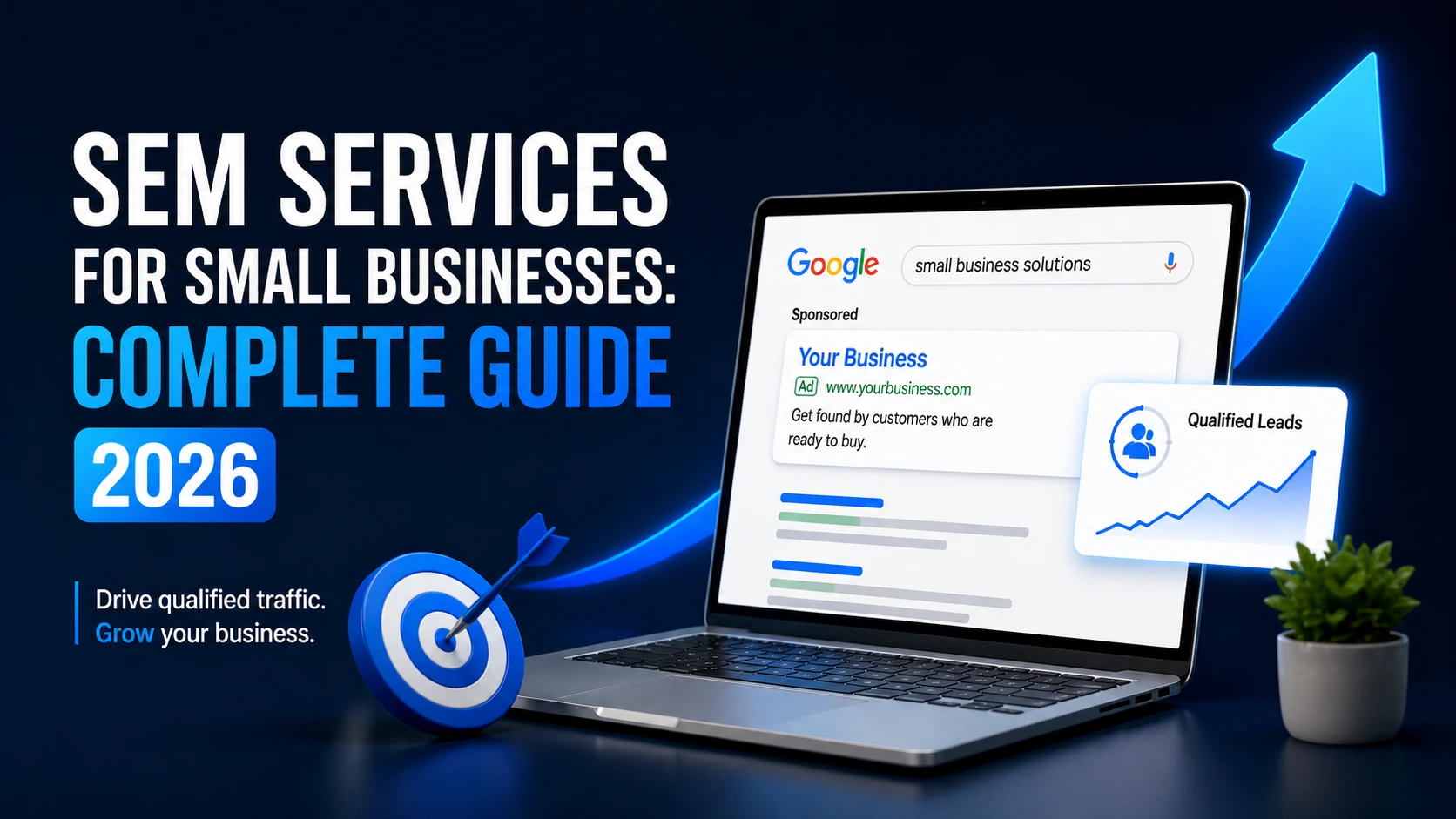
SEM Services for Small Businesses: Complete Guide 2026

InitiumX Team
Digital Marketing Specialists
Small businesses need search engine marketing more than anyone else. They are competing against established brands with larger budgets, less organic brand recognition, and fewer referral networks. Paid search is one of the few channels that levels the playing field — if you can afford it.
That is the problem. Most US SEM agencies price small businesses out of the market. Management fees run $3,000-8,000 per month before a single dollar goes to ads. For a company with a $10,000 monthly marketing budget, that means 30-80% of spend goes to management overhead. It does not have to work that way.
Search engine marketing services exist on a spectrum of quality and price, and the gap between what you pay and what you get is wider in SEM than almost any other marketing channel.
What Does an SEM Service Include?
SEM — search engine marketing — refers primarily to paid search campaigns on platforms like Google Ads and Microsoft Advertising (Bing). When done correctly, it encompasses more than just “running ads.”
A full SEM service includes:
Keyword research and strategy. Identifying which terms your target customers actually use, separating high-intent commercial queries from informational ones, and mapping keywords to specific campaign structures.
Campaign architecture. Structuring ad groups, match types, and bidding strategies correctly from the start has compounding impact on performance. Poor architecture is the root cause of most wasted ad spend.
Ad copy creation and testing. Writing ads that match search intent and drive qualified clicks. This includes writing multiple variations and running systematic A/B tests to improve click-through rates over time.
Landing page alignment. Ads that send traffic to generic pages underperform ads linked to pages built for the specific search query. A good SEM service either builds those pages or advises on them.
Bid management and budget optimization. Adjusting bids by device, time of day, audience, and keyword performance to push spend toward what converts and pull it from what does not.
Conversion tracking setup. If you cannot measure what happens after the click, you cannot optimize. Proper tracking setup — goals, values, attribution — is foundational.
Reporting. Monthly reporting that explains what changed, why, and what is being done about it. Not just numbers — interpretation.
Any agency quoting you a “SEM management” fee that does not cover all of the above is selling you a partial service.
Google Ads vs Meta Ads vs LinkedIn — Which for Small Business?
The right platform depends on what you are selling and who you are selling to.
Google Ads captures demand that already exists. Someone searching “commercial HVAC repair Denver” is actively looking for that service. Google puts your ad in front of that person at the exact moment of intent. This is the highest-converting channel for service businesses, professional services, and any product where customers search before buying.
Meta Ads (Facebook and Instagram) create demand by interrupting people who are not actively searching. They work well for visually compelling products, local awareness campaigns, and retargeting website visitors. Meta is more effective for B2C brands than B2B. Costs per acquisition tend to be higher for service businesses compared to Google.
LinkedIn Ads are expensive — CPCs often run $8-15 compared to $1-5 on Google — but they are the only platform where you can target by job title, company size, and industry simultaneously. For B2B companies selling to specific decision-makers, LinkedIn can outperform all other paid channels despite the higher unit costs.
For most small businesses with limited budgets, Google Ads should come first. Capture the intent that already exists before you invest in creating new demand.
How to Evaluate SEM Agencies
Red flags that should end the conversation:
- They guarantee specific rankings or specific ROAS numbers before running a single test. No legitimate agency can guarantee results in paid search.
- They cannot explain their fee structure clearly. If you cannot get a straight answer on what management costs cover, they are hiding something.
- They keep you out of your own ad account. Your Google Ads account should belong to you, not the agency. If they insist on managing under their account, you lose all historical data if the relationship ends.
- Their reporting is a wall of metrics with no interpretation. Volume of data is not insight.
Green flags worth paying attention to:
- They ask about your business goals before talking about tactics. An agency that leads with strategy questions is thinking about outcomes, not just activity.
- They have worked with businesses in your industry or adjacent industries. Learning curve costs you money.
- They can explain what they will and will not control. Good agencies are honest about what paid search can and cannot do.
- They set 90-day expectations, not 30-day promises. SEM optimization takes time.
What Results Should You Expect in 90 Days?
Month one is infrastructure. Campaign setup, tracking verification, initial keyword testing, landing page review. Expect higher CPCs while the algorithm learns.
Month two is data. Enough conversion data starts accumulating to see patterns. Which keywords drive clicks but not conversions. Which ad copy variants outperform. Which audiences over-index. This is where strategic adjustments begin.
Month three is optimization. Bids adjusted to actual performance data. Poor performers paused. Budget rebalanced toward what works. By the end of month three, a well-managed Google Ads account typically sees 20-35% improvement in cost-per-conversion compared to launch.
If an agency promises significant results in 30 days, they are either lying or they are about to spend your budget recklessly to manufacture short-term numbers.
What you should realistically expect by day 90:
- Stable conversion tracking with clean attribution data
- Cost-per-click trending down as quality scores improve
- 2-3 clear learnings about which audience or keyword segments convert best
- A baseline cost-per-acquisition to optimize against in months 4-6
The Nearshore SEM Option
The structural cost problem with US SEM agencies is not a quality problem — it is an overhead problem. US agencies pay US salaries, US office costs, and US account manager compensation. Those costs get passed to you in the management fee.
Nearshore SEM teams operating from Honduras carry a fraction of that overhead. InitiumX offers SEM management services at rates that make the channel viable for businesses with $2,000-5,000 monthly ad budgets — budgets that US agencies routinely turn away.
The work is the same: keyword research, campaign architecture, copy testing, bid management, conversion tracking, monthly reporting. The difference is that the management fee does not consume 40-60% of your total marketing investment.
Same quality. Certified Google Ads practitioners. English-language communication. Central Time availability. 60% lower management fees.
Get a free SEM audit from InitiumX — we’ll review your current campaigns or your competitor landscape and tell you exactly where paid search opportunity exists for your business.
InitiumX Team
Digital Marketing Specialists
Software development and digital transformation expert at InitiumX.