
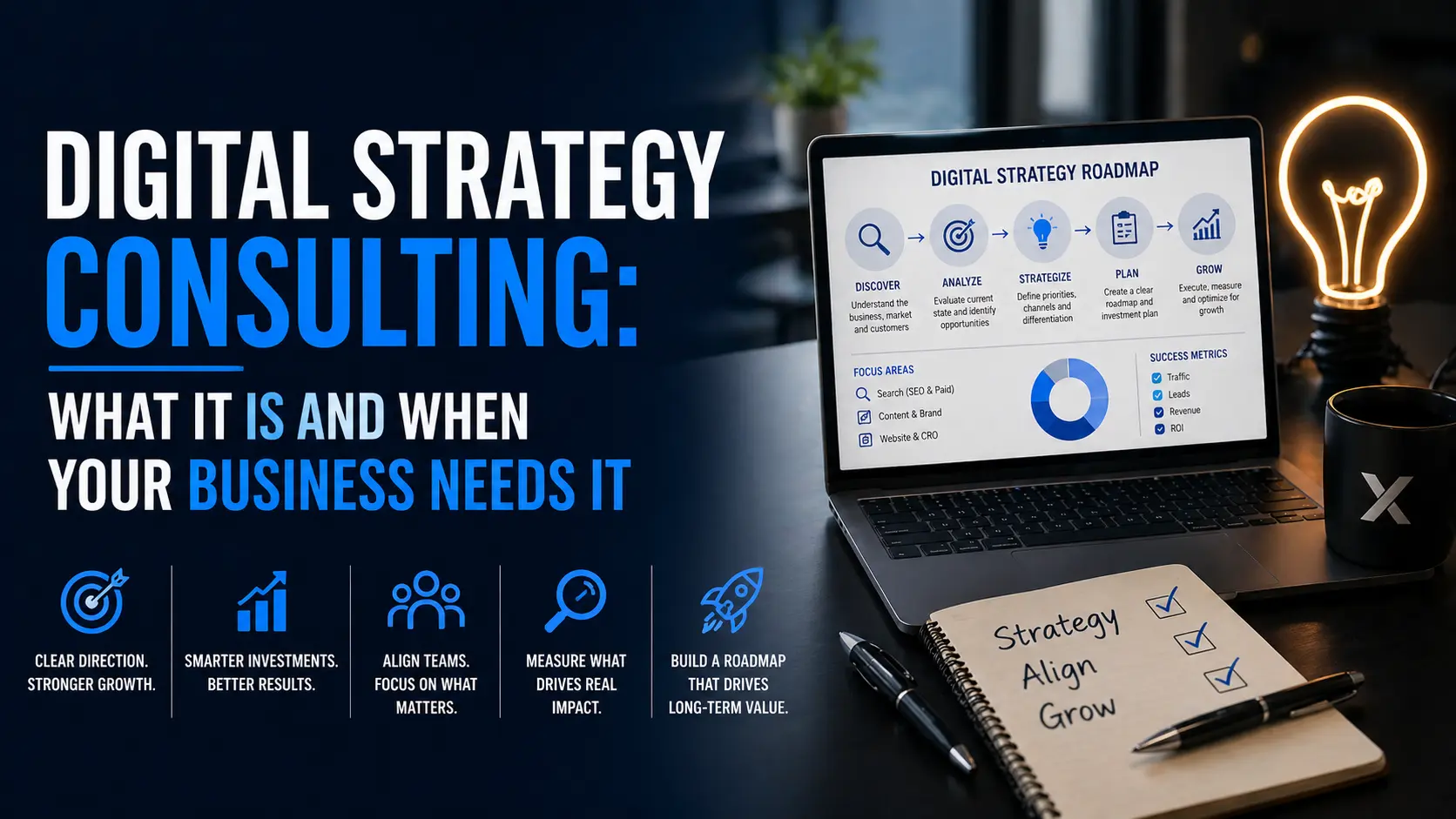
Digital Strategy Consulting: What It Is and When Your Business Needs It

InitiumX Team
Digital Strategy Specialists
Most businesses know they need to “do more digital.” They are less clear on what that means in practice, which channels to prioritize, how much to invest, or how to measure whether it is working. That gap between knowing you need a digital presence and knowing what to build is exactly where most companies stall — and where the cost of inaction starts compounding.
Digital strategy consulting exists to close that gap. Not with a generic framework or a slide deck full of buzzwords, but with a specific, prioritized plan tied to your actual business objectives.
The companies that invest in digital strategy early build compounding advantages. The ones that wait until they’re losing market share spend twice as much to catch up.
What Is Digital Strategy Consulting?
Digital strategy consulting is the process of analyzing a business’s current market position, digital footprint, customer acquisition channels, and competitive environment to produce a prioritized roadmap for digital growth.
The output is not a website. It is not a social media plan. It is a documented strategy that answers:
- Which digital channels have the highest potential return for this specific business?
- What is the current state of the digital infrastructure, and what needs to change?
- How should marketing investment be allocated across channels over the next 12 months?
- What metrics define success, and how do we track them?
- What is the sequencing — what needs to happen first for everything else to work?
A digital strategy consultant brings an outside perspective that internal teams rarely have — not because internal teams lack intelligence, but because they are too close to day-to-day operations to see the gaps clearly.
5 Signs Your Business Needs a Digital Strategy Consultant Now
1. You are spending on digital marketing but cannot explain what it is generating.
If you have active Google Ads campaigns, a social media presence, or an SEO retainer, but you cannot trace those investments to specific revenue outcomes, you have a strategy problem. Tactics without strategy produce activity, not results.
2. Your competitors are visibly outpacing you online.
They are appearing in searches where you are not. Their content is ranking. Their reviews are accumulating. They show up in multiple channels and you are in one. This is not a single-channel problem — it is a strategy gap.
3. You are about to make a significant digital investment.
Building a new website, launching paid advertising, or migrating platforms is expensive. Going into those investments without a clear strategy means you may build the wrong thing, on the wrong platform, for the wrong audience. A strategy engagement before a major investment typically costs far less than fixing a misaligned execution.
4. Your team disagrees on priorities.
Marketing wants to focus on social. Sales wants better lead quality. Leadership wants to understand the ROI of all of it. When internal stakeholders cannot agree on digital priorities, it is because there is no coherent strategy to align around. That is a solvable problem.
5. You are entering a new market or launching a new product line.
An existing business entering a new vertical or geographic market does not automatically transfer its digital advantages. A fresh strategy assessment prevents you from assuming what worked in market A will work in market B.
What a Digital Strategy Engagement Looks Like
A structured digital strategy engagement typically runs four to six weeks and moves through three phases.
Phase 1: Discovery and Audit (weeks 1-2)
The consultant takes stock of what currently exists: website performance, SEO footprint, paid search history, analytics configuration, social presence, email list health, and competitive positioning. This is not a qualitative assessment — it is data-driven. Tools like Semrush, Ahrefs, Google Analytics, and Search Console produce the evidence base for recommendations.
Deliverables: audit report covering channels, gaps, and initial observations.
Phase 2: Strategy Development (weeks 2-4)
Based on the audit, the consultant builds the actual strategy: channel prioritization, budget allocation framework, 90-day quick wins, 12-month roadmap, and KPI framework. This phase includes stakeholder interviews to ensure the strategy reflects actual business priorities, not just marketing metrics.
Deliverables: strategy document, channel roadmap, KPI dashboard template.
Phase 3: Handoff and Activation (weeks 4-6)
The strategy is only useful if it gets implemented. A good engagement ends with a clear handoff: internal team training, vendor selection support if needed, and a 30-day check-in to verify implementation is on track.
Deliverables: implementation guide, vendor shortlists if applicable, onboarding session.
How to Choose a Digital Strategy Consultant
The market for digital strategy consulting is crowded with generalists who apply the same framework to every client. Here is how to tell the difference.
Ask to see work from your industry. A consultant who has only worked with B2C e-commerce brands will have significant blind spots when advising a B2B professional services firm.
Ask what they will not do. Good consultants have a clear scope. If a consultant promises to handle strategy, execution, creative, analytics, and paid media all at once for a small monthly retainer, they are overpromising.
Ask how they measure success. If the answer involves vanity metrics — impressions, followers, reach — without connecting to business outcomes like leads, revenue, or customer acquisition cost, that is a problem.
Ask about their process for the first 30 days. Specific process beats vague promises. A consultant who can walk you through their exact discovery methodology is more likely to deliver than one who speaks in marketing abstractions.
InitiumX offers digital strategy consulting as a starting point for clients who want to build a digital presence that actually generates business. We combine strategy with execution — we can develop the roadmap and then implement it, or hand off to your internal team.
Expected ROI and Timeline
Digital strategy is not a channel with a direct, measurable return like a Google Ads campaign. Its ROI is measured in the efficiency gains it creates downstream.
What you can reasonably expect:
- 30 days: Clear prioritization. No more budget wasted on channels that do not fit your market.
- 90 days: First evidence of impact. Organic rankings starting to move. Paid campaigns structured correctly and generating baseline data.
- 6 months: Compounding returns. Channels that were set up correctly in month one are now generating predictable leads or revenue at a defined cost.
- 12 months: A mature digital acquisition system where you understand which channels drive which outcomes and can model investment increases against expected return.
The businesses that see the highest ROI from digital strategy consulting are those that treat it as the beginning of a systematic build, not a one-time deliverable.
Book a strategy session with InitiumX — we’ll assess your current digital footprint and tell you exactly where the highest-return opportunities are for your business.
InitiumX Team
Digital Strategy Specialists
Software development and digital transformation expert at InitiumX.